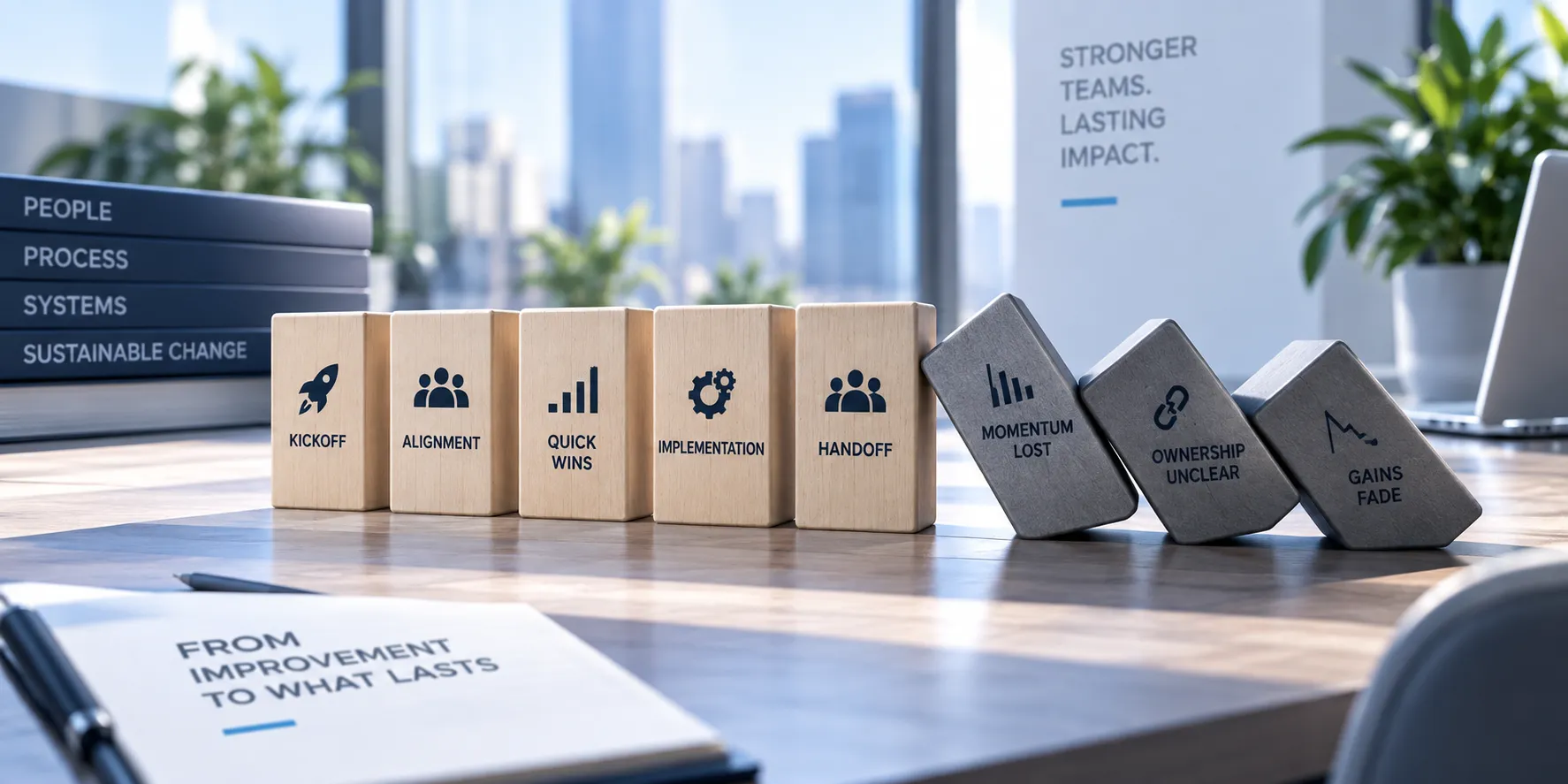
The first ninety days of a transformation program are usually the best ones. Energy is high. Leadership is aligned. Quick wins are being delivered. There is a sense that this time, things will be different.
Then something shifts. The consultant scales back. The internal champion gets pulled into other priorities. The improvement plan gets filed somewhere and reviewed less frequently. Six months later, the organization has a fraction of the gains it originally achieved, and leadership is wondering whether the investment was worth it.
This is not an uncommon story. It is the predictable result of a transformation program that delivered capability but did not build sustainability.
Why Gains Disappear
No capability transfer
The consulting team solved the problem. But the client's team was never built to own the improvement going forward.
No measurement systems left behind
When the reporting stops after the engagement ends, there is no signal that performance is drifting back toward the baseline.
No process ownership
The improvement existed because someone external was driving it. When they leave, the process has no internal owner with the authority and skills to sustain it.
What We Did Differently — And What It Produced
When we worked with a healthcare e-learning platform struggling with customer onboarding, we reduced median implementation time from 209 days to 78 days and improved first-pass quality from 12% to 50%. But the final phase of that engagement was not celebrating those results.
It was designing and launching a Continuous Quality Improvement succession plan that gave the client's own team the tools, the process ownership, and the measurement systems to sustain and build on those improvements independently.
At a Glance
- 209 → 78 days
- Median customer implementation time reduced - 63% improvement
- 12% → 50%
- First-pass quality improvement - more than 4x
- Self-sustaining
- CQI capability established - gains are not consultant-dependent
How We Build for Sustainability
Define success metrics upfront
KPIs are agreed before the engagement starts - not defined at the end. The client knows what they are measuring and why.
Build internal ownership at every stage
We do not execute for the client - we execute with them. Every workstream has an internal owner who is building capability alongside us.
Transfer the methodology, not just the outcome
We document the approach, train the team, and ensure the process can be run independently before the engagement closes.
Design the succession plan
The final deliverable is always a clear plan for how the organization continues the improvement journey without external support.
This is for you if
- You want a partner who builds your team's capability, not just your results
- You are ready to own the improvement process after the engagement
- You measure success by what the organization can do after we leave
We may not be the right fit for you if
- You want a consulting team to manage the process indefinitely
- You are looking for quick results without internal change
Ready for a Transformation That Sticks?
If you are ready to change how your organization operates - not just how it performs for ninety days - let us have that conversation.