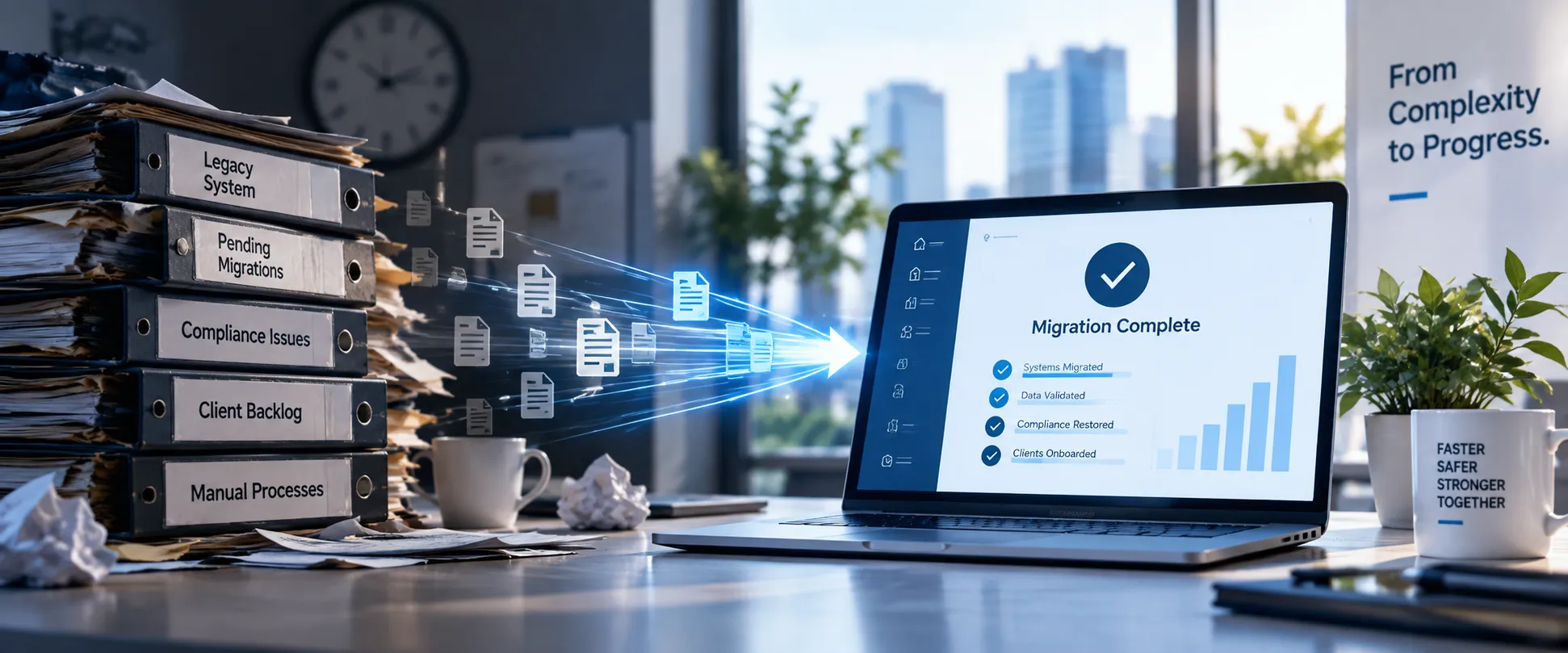
Most organizations believe that speed comes from pressure — tighter deadlines, more hours, bigger teams. We have learned, through years of execution work, that the opposite is true. Real speed comes from clarity, preparation, and structured execution. When those three things are in place, what used to take months can happen in days.
The Problem
A healthcare SaaS client had a seven-year-old initiative to migrate from a legacy sample processing engine to a modern platform. Seven years. The migration was proceeding at ten hospital clients per quarter. Several customers had already fallen out of compliance as a direct result. One was at risk of bankruptcy. The Centers for Medicare and Medicaid Services had issued formal warnings.
At a Glance
- 7 years
- The initiative had been running without completion
- 10/quarter
- Migration rate before the engagement
- 389
- Individual hospitals migrated in the 19-hour execution event
What We Did
Assembled the right team
A 12-member cross-functional team of engineers, operations staff, and QA specialists — the people who actually owned the work.
Built custom tooling
19 new SQL stored procedures developed specifically to accelerate the migration process before the event began.
Piloted before scaling
Five client systems migrated end-to-end to validate the process and identify time-saving shortcuts before the main event.
Distraction-free execution
A 19-hour immersive event over three days — no emails, no IMs, no phone calls. Hourly progress dashboards visible to the entire organization.
Closed the initiative
389 hospitals across 47 hospital system clients migrated. A seven-year project completed in under a day of focused execution.
The Real Lesson
Rapid execution is a design problem, not a willpower problem. Most organizations never create the conditions for it. Work is fragmented across priorities. Experts are never fully available. Processes are not piloted before they are scaled. Nobody owns the outcome end to end.
Clarity of scope
Everyone in the room understood exactly what success looked like before the event started.
Cross-functional ownership
The right people with the right skills were present and focused — no escalation chains, no waiting for approvals.
Validated process
The pilot runs meant the team was not figuring out the approach during the event. They were executing a proven playbook.
Real-time visibility
Hourly dashboards kept the entire organization informed, creating momentum and organizational accountability.
Your Organization Has Stalled Initiatives Too
If your organization has projects that have been running far longer than they should, we would like to help move them forward.