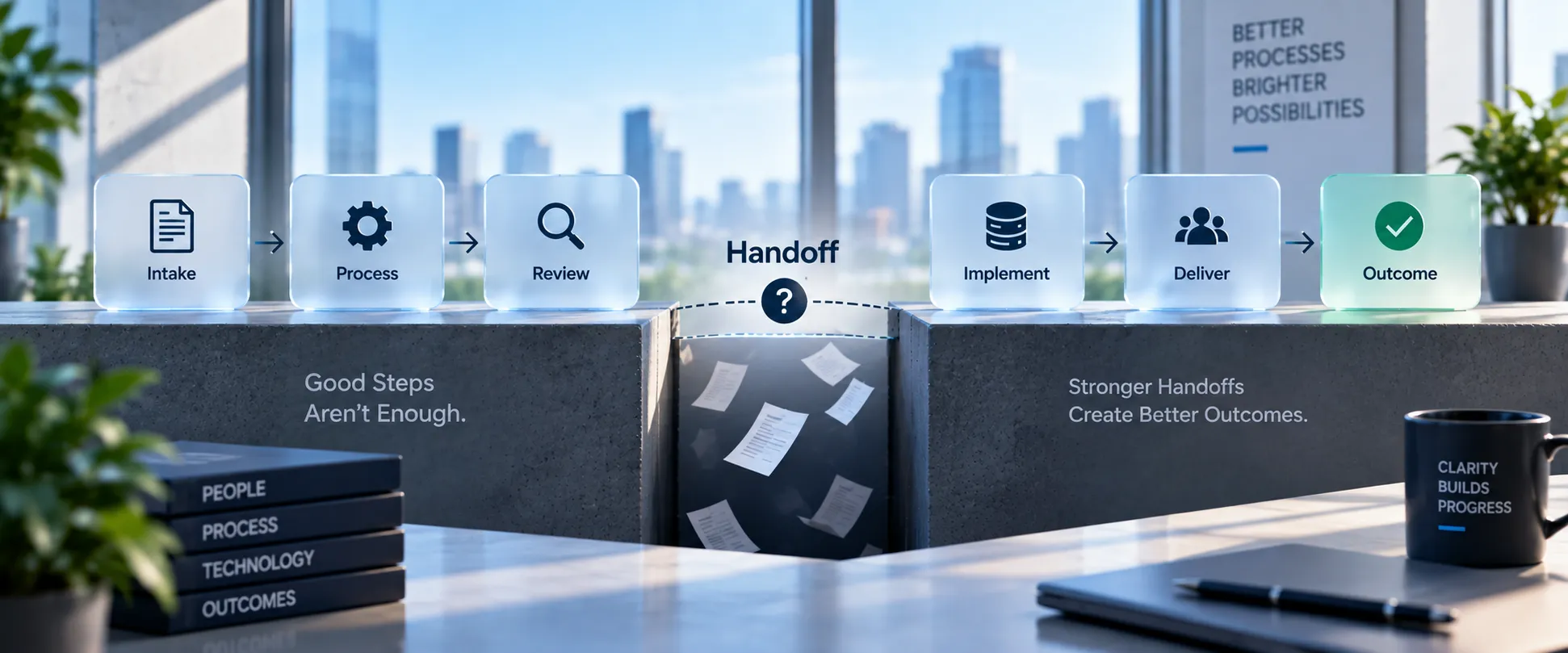
Most process improvement efforts focus on the steps. They map out the workflow, identify where things are slow or error-prone, and redesign the problematic steps. It is a reasonable approach. It is also often the wrong one.
In our experience, the most costly problems in any operational system do not live inside the steps. They live in the handoffs between them — the moments where ownership transfers from one person, team, or system to another.
Where Problems Actually Live
Accumulated assumptions
Handoffs are where teams assume the receiving party knows what they are getting. When that assumption is wrong, the error compounds silently downstream.
Unclear accountability
The moment between step A and step B is where nobody owns the outcome. Problems in that space get noticed only when they surface as a customer impact.
Missing recovery mechanisms
Steps have defined processes. Handoffs rarely do. When something transfers incorrectly, there is no structured response — just firefighting.
What This Looked Like in Practice
A healthcare client was experiencing data loss that was causing patients to miss Medicare reimbursements. The individual steps in the data intake process were functioning as designed. The failure was happening at the transition between the legacy intake method and the new automated platform - a handoff that nobody owned cleanly, and that had not been fully stress-tested in production conditions.
The result was an existential compliance risk that only became visible once it had already compounded into a backlog of affected hospital clients.
How We Find What Others Miss
Map the white space
During value stream mapping, we deliberately spend more time on the space between process steps than on the steps themselves.
Ask the ownership question
For every handoff: who hands off to whom, what does the receiver assume, what happens when that assumption is wrong, and who owns recovery?
Assign clear ownership
Problems without owners do not get fixed. We make handoff ownership explicit - named, documented, and agreed to by both parties.
Design failure recovery
We build structured responses for when handoffs do not go cleanly - before those failures happen in production.
This is for you if
- Your operations are underperforming despite process improvement efforts
- Teams are aligned internally but something breaks at the boundaries
- Compliance or quality issues appear downstream with no clear upstream cause
We may not be the right fit for you if
- You want a partner who will validate your current process design
- You are looking for a quick fix without root cause analysis
Start the conversation